

Select a title below to view full question and answer.
Sell Home Yourself? Buy the best home for your money - in a good location - and enjoy your blue chip investment.
Doesn't it make sense for me to sell my house on my own? This way I can pocket the Realtor's commission. Right?
Wrong! It's not that simple. For one thing, the typical buyer is no fool. He'll expect you to deduct the commission for HIS benefit before you even start serious negotiations. Then you're on your own to handle some tough bargaining, curiosity seekers, credit checks and intricate financial arrangements. In the long run, you'll find that a Realtor will sell it for the best price and in the shortest amount of time. You've got a lot invested in your home. It makes sense to sell it the professional way.
Home - A Blue Chip Investment Don't underestimate the buyer. Sell your home the professional way.
One normally refers to stocks and bonds as blue chip investments. Shouldn't real estate be included in this category?
A well-built home in a good neighborhood is, indeed, a blue chip investment. In fact, real estate values - long term - increase more than the value of stocks and bonds. And housing values have always more than kept abreast of the general rise in consumer prices.
There is no reason to believe that this situation will change in the future. There is an increasing demand for homes. Also, real estate tax breaks allow you to keep more of what you earn. It's a blue chip investment - plus!
Curiosity Seekers How do you limit them when you sell a house?
Overpricing Can Be Costly Overpricing a house will lose more good prospects than anything else.
A Family Decision The FINAL homebuying Inspection should be made with BOTH husband and wife.
In your opinion, how much of the home-buying decision should be a family process?
It's desirable that house-hunting be done by husband and wife wherever possible. However, in the case where a move over a considerable distance is involved, the best arrangement is for either the husband or wife to look separately and then for both to get together to make the final decision-making inspection.
Financing "Handyman Special" You can finance your "Handyman Special" based on future value - after improvements.
I have a chance to buy a "Handyman Special" worth $96,000 for only $80,000 because it needs repairs. I can arrange for the $80,000 but need another $16,000 for repairs. Help!
Your answer may be a construction commitment loan based on the future value of your home - after improvements.
If the bank agrees to an 80% loan, it will give you $64,000 (80% of the $80,000 sales price) for payment to the seller. It will release the remaining $12,800 (80% or the $16,000 improvements) when the work is completed.
Which Opinion is Right? The value of your home is determined by the local market.
Should You Pay Off Mortgage? Think twice before paying off an old mortgage early. The money might be better invested.
Paint Before Selling? A house badly in need of painting will discourage sale at the best price.
Inflation is Inflation During inflation, you'll make more money in real estate than if you hid the money in the mattress.
On Including Extras Including "extras" will make a buyer happy -- but do it right!
Be Wary of Net Listing Beware of selling your home with a net listing. It is open to much abuse and is often illegal.
I told my real estate agent that I wanted $120,000 for my house. He offered to sell it if he could keep anything OVER that amount as his commission. What do you think?
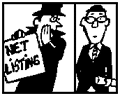
If an agent proposes to guarantee you a certain sum from the sale of your home in return for the chance to keep anything OVER that amount, you have been offered a "net listing". This arrangement is open to so much abuse that it is illegal in about half the states.
Any number of complications can arise. The AGENT'S interests are now paramount although the law requires that you, the client, must come first.
Homeowner Tax Winner Homeowners are exempt from capital gains taxes on up to $500,000 profit on a sale.
Financing Decision Deciding between a fixed or variable mortgage should be a last-minute decision.
That Beautiful Leverage LEVERAGE is the key to multiplying profits from real estate.
Don't Count on Oral Promise Handshakes don't count in real estate. Put it in writing.
I am about to purchase a new home. The builder promised that everything wrong will be taken care of and that his handshake will save a lot of paperwork. Should I trust him?
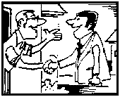
Many a business agreement has been made with a handshake and enforced by the courts. But when it comes to the never-never world of real estate, you cannot and should not rely on oral promises. In fact, the law in all states specifically requires that all agreements and conditions relative to the sale of real estate specifically be in writing to be enforceable. The way to put teeth into oral promises is to insist that everything significant be put in writing.
The Solo Act The fastest way to sell your house is to let the Realtor show it alone.
The Great Inflation Hedge There's no better inflation hedge than ownership of a home.
Why does everyone say that home ownership is one of the great hedges against inflation?
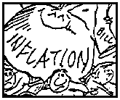
For one thing, your monthly installment payments never change (unless you have an adjustable rate mortgage). Also, your investment grows as the value of your home increases with rising prices. On top of that, you enjoy some fine tax advantages, especially the property tax and mortgage interest deduction.
There is no better inflation hedge than ownership of a home. And, most importantly, real estate values have always increased faster than the cost of living.
Setting the Stage Don't sell a house, sell a home. Subtle showmanship can help set the right atmosphere.
Why a Title Search? A title search will check for "clouds" on the title, such as unpaid taxes or other claims.
Why is a title search necessary when you buy a home?

Skipping the title search is like buying a new car without a warranty -- except the stakes are higher. Although you may be the only buyer, others may also claim rights to the property. There may be an easement to restrict the use of your land or unpaid taxes. An heir to a former owner may claim a share of the property. A title search will check for any such possible claims and determine if the title is clear. Your deed does not eliminate claims that others may have. It simply transfers the seller's right of ownership to you.
Home Buying Psychology Overpricing will hurt a sale. Buyers compare prices, so you may lose some good prospects.
Just how important a factor is overpricing when selling a home?
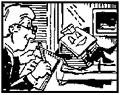
Buyers buy homes by comparison. The average buyer is no slouch. He'll shop a particular neighborhood and home type. He'll rarely buy the first one he visits. It's too big an investment to be nonchalant. He will then compare prices against comparative value. He'll quickly throw out any obviously overpriced homes.
If the buyer really likes an overpriced home, he may make a counter offer at a lower price -- closer to its true value. Historically, the buyer probably will make his offer for one properly valued. Overpricing will hurt a sale.
Restriction Clause Deeds should be checked carefully for restrictions.
What is meant by a restriction?
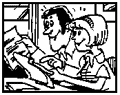
It is a clause in a deed restricting the use of the property. It might be looked upon as zoning on a very personal basis.
For example, a house in a commercially zoned area may have a restriction against use for any commercial purpose. This could create future financing problems because banks may refuse to loan money for other than commercial use.
From the point of view of the buyer, it is preferable that the agreement enumerate any and all restrictions. Bring them out in the open and get professional advice before going any further. It's for your own protection.
Wrong Pricing Logic How do you set a realistic selling price? It's best to have professional help in this vital matter.
Why do so many homeowners go wrong when they try to set a realistic selling price?
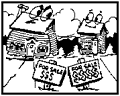
Most people base their price tags on these factors: Original price, cost of improvements, hoped-for profit and what they think similar homes are bringing. The original price, improvements, and hoped-for profit only determine whether you gain or lose, but they have nothing to do with the right price to produce a sale. Prices of other homes? Most of the time you only hear of the asking price, not the selling price.
Solution: Consult a local Realtor whose business it is to KNOW how much a property can and will bring.
Financial Independence Ownership of real estate is the major source of wealth for those in retirement years.
How does real estate investment fare as in a method of making you financially independent in retirement?

Being financially independent in your later years is a feat by itself. According to a study by the U.S. Government, of all people over the age of 65, only 6% are financially independent. Also, according to this same study, all of the lucky segment became financially independent partly or wholly through ownership of real estate.
No one buys their first home as a reason for financial independence at retirement, but that's the way it often works out.
Let There Be Light The brighter the better when showing a home. Full illumination gives that "lived-in" look.
Do you have any suggestions on how much a home should be lighted when being shown to a prospective buyer?

In my opinion -- the brighter the better! Give the prospect the best image you can of the comfort, beauty and livability you are offering. In other words, you want to sell a home, not a house. Full illumination is the best way to give your home the "lived-in" look. Furniture, rugs and fixtures take on a warm glow from the proper lighting. Kitchens should always be bright, turn on lights in all rooms and especially in closets and storage rooms. The brighter -- the better.
Importance of Comparables The sales price of your home must be based on comparable sales in your immediate area.
Printed Form Fable It's what goes into printed forms that gives value and protection.
The Counter Offer There are important facts to know before making a counter offer.
Looking? Keep a Record Keep notes when house-hunting to save frustration when comparing houses.
I'm house-hunting and get confused when I try to remember the details of each house I viewed. Any advice?

Once your Realtor takes you house-hunting, he or she will probably show you several. Therefore, it's important to take notes on what you have seen or you may forget which home is where, how big it is, what shape it's in, and the price.
Your Realtor can provide you with a checklist to make this task easier. This way, you can instantly recall the location, price, construction, number of rooms, heat, fuel, taxes, and financial requirements. A photograph of the house to go with the notes helps, too.
Costly Improvements Beware of making major improvements before putting your house up for sale.
House Value vs. Lot Value The relationship between the cost of the lot and cost of the house is important.
What is the proper relationship between the cost of the lot and the value of the house on it?

Old rules of thumb have lost much of their meaning. It used to be that land represented about one-sixth of the home's purchase price. Then it moved up to one-fourth. And it will change again as the cost of land continues to rise or fall.
Nevertheless, the land value versus house value ration cannot be totally dismissed because it does, to some extent, affect the resale value of the property. It may not make much difference if you put an inexpensive house on an expensive lot, but it could be a mistake to have too much house for the land.
Should I Rent with Option? Renting your house with an option to buy, reduces your prospects to one!
My home is for sale. One prospect offered to rent it with an option to buy. What is your advice on this situation?
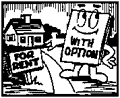
The "Rent with option to buy" offer is usually made by someone who is not a serious buyer for ANY house. I'd suggest putting the offer aside and looking for a bonafide prospect who wants to BUY the house -- not rent it. However, if you MUST rent your home under these circumstances, be sure that there is a consideration for the option over and above the rent. Remember, you are reducing your sales prospects down to one - and that one is quite dubious.
Closing Costs Deductions Many closing costs are deductible. Keep good records so as not to lose any.
I signed a lot of checks during the closing of the purchase of our home. Can you tell me which closing costs are deductible from my income tax?

Property taxes are usually pro-rated so that both the buyer and seller each pay the taxes for the portion of the year that each owns the property. Each may deduct this amount. Another deductible item is interest charged to the seller on the mortgage up to the date of closing. Also deductible as interest is the amount charged as points.
Fire insurance, FHA mortgage insurance, and charges for rent for occupancy before closing are not deductible.
Selling at a Loss There are ways to soften the blow if you sell your home at a loss.
Rent Home Out or Sell It makes more sense to sell your house than to rent it out.

© 2026 Patricia A. Skiba Realty • patriciaskibarealtor@realtor.com • pat@pskibarealty.com
4044 Butler Pike Plymouth Meeting, PA 19462 Office: 610.825.5430 Cell: 610.825.5432
Website Designed and Developed by AG Marketing Solutions
Conshohocken PA Real Estate | Conshohocken PA Homes For Sale | Conshohocken PA Realtor | Conshohocken PA Residential Real Estate | Conshohocken PA Residential Homes For Sale | Conshohocken PA Residential Realtor | Selling Homes in Conshohocken PA | Homes For Sale in Conshohocken PA | Real Estate in Conshohocken PA | Residential Homes For Sale in Conshohocken PA | Realtors in Conshohocken PA | More Resources